Swedish news, week 47 in 2026
The government
We still don't have a new one. The speaker said we'll have a decision about either the government or an extra election by Christmas.
ID news
Skatteverket will not make identity cards for Swedish non-citizens anymore; starting 1st of December, it becomes the responsibility of Polisen. These new identity cards will be connected to the new SverigeID thing, which is like BankID, but from the government. If you're already a citizen and get a new national card after the 1st of December, you'll get SverigeID with it too, but it now costs 500 SEK instead of 400.


Healthcare news
The flu-and-covid season is here, a bit early this year. Folkhälsomyndigheten (the Public Health Agency of Sweden) is encouraging the high-risk groups to vaccinate.


The Stockholm region has achieved the goal of halving the antibiotics prescriptions per 1000 people with no increase in serious infections. The goal was set to help prevent all the bacteria becoming resistant, but still give the antibiotics to those who need them.
 Region Stockholm
Consumer news
If you've been buying stuff from Amazon, AliExpress, CDON, Shein, Temu, Wish or Fyndiq, you should know that Kemikalieinspektionen (the Swedish Chemicals Agency) with friends (e.g. Elsäkerhetsverket, the National Electrical Safety Board) have tested a lot of products sold there and they were not impressed:
- 32 out of 40 electrical products they've tested had problems like risk for an electrical shock
- banned substances were found in 104 of the 131 products tested, including lead in electronics, cadmium in jewelry, and banned phthalates in soft plastic products; these fun substances can for example damage the nervous system, affect fertility, and of course cause cancer
- deficiencies were found in 6 out of 9 toys for small children, including small, loose parts that kids could choke on and excessively loud sound levels
- sunscreen products were marketed with unauthorized and misleading claims about their sun protection effects


Starting-a-farm news (Skåne)
Getting financial support if you're younger than 40 and want to start or take over a farm is not really news, but the Skåne region is informing its residents that it got extra money exactly for that.


Reports and data
SCB (Statistics Sweden, a government agency) is seeing some positive signs in the labor market. The number of unemployed people aged 15–74 decreased to 500 000. The unemployment rate also decreased to 8.6%.

Fritidskortet was used by more than half a million kids this year. It's 550 SEK that a child aged 6–16 can use on recurring activity fees in sport, culture, friluftsliv (outdoors), kulturskola, or from other registered youth associations.




SKR, Swedish Association of Local Authorities and Regions, has published its yearly report about the Swedish healthcare.
Some highlights:
- Mortality is stable and low compared to other EU countries. This is not equally distributed though: the gap between the highest- and lowest-income groups has tripled for men since the 1960s (from 3.5 years of life to 11), and women show a similar but less pronounced trend. The trend toward longer lives doesn't reach everyone equally either.
- Cardiovascular disease (the biggest killer in the world and in Sweden) has seen falling mortality across the entire 2000s, and the decline will probably continue. In some of Sweden's regions, tumors have overtaken cardiovascular disease.
- 5-year relative survival (all cancers combined) is up 12% for women and 14% for men since 2004.
- Type-1 diabetes in children: the share of kids/teens with good long-term blood sugar control went from 16% (2010) to 61.3% (2025).
- Psychiatry is under strong strain, especially for the kids/teens: BUP demand is rising, driven in part by ADHD diagnoses; medicine prescriptions are up but at least the costs fell, because manufacturers were forced to cut prices. The new prioritization guidelines are meant to catch patients needing care earlier and to free up resources for patients with clear functional impairment as opposed to mild/low-impact ADHD cases. Forensic psychiatry is under strain too: number of people in care are up 59% over 2014–2025, every region was over 100% occupied as of January 2025, and costs for the regions are up 35% in six years.
- Not a single region met the vårdgaranti requirements in specialized somatic care.
- 63% of residents report high or very high trust in their region's healthcare (higher for hospitals, lower for vårdcentraler).
- 87% of residents think that they have access to the healthcare they need. 57% of residents believe healthcare is delivered on equal terms (64% of men vs 51% of women).
- Primary-care availability decreased slightly after a few years of improvement, the 3-day assessment rate went from 88% to 86% in 2025.
- Healthcare costs as a proportion of GDP have remained relatively stable for a long time. Meanwhile, regional costs are increasing faster than can be explained by price and wage growth or by changes in the population’s size and age structure.
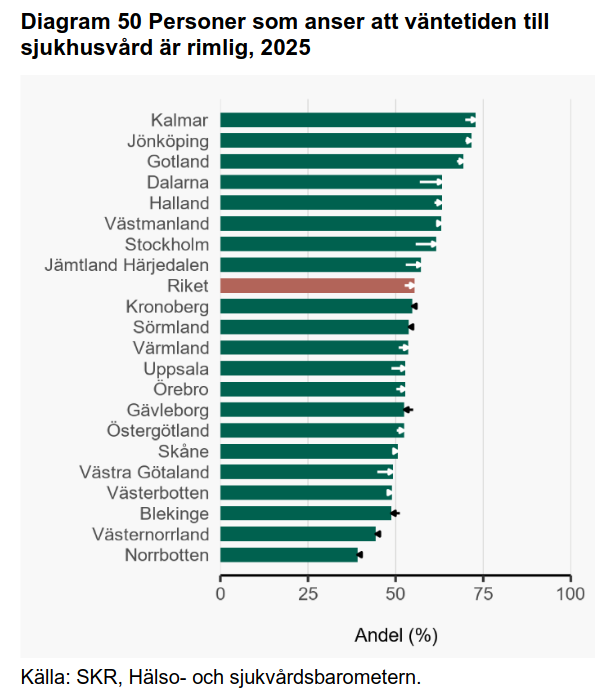
- Barely over half of residents consider waiting times for hospital care reasonable. That's the country average; you can see the breakdown by region on the diagram below.

Events
If you're going to Dreamhack next week, you can meet some government people: they'll have a booth there.